
Experimental, abstract photographer from Thomas, W.Va. In the gallery July 12-August 9, 2026
By Carl E. Feather / Tucker County Observer
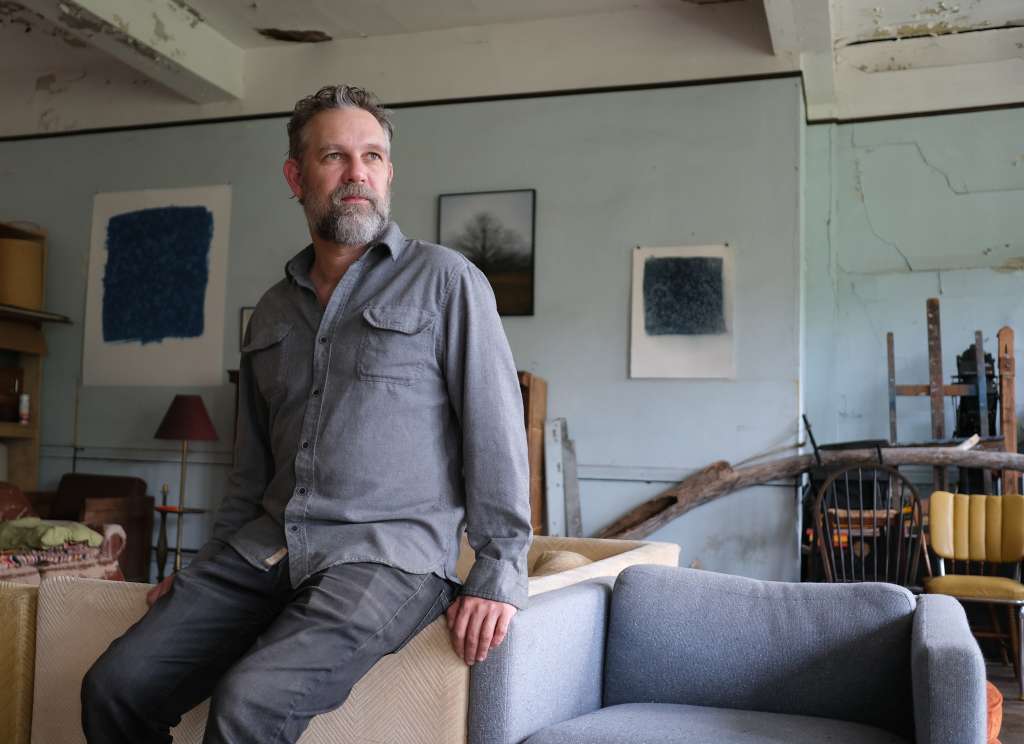
From 19th-century techniques to composites of hundreds of digital images, the abstract work of Thomas-based photographer John Ryan Brubaker redefines the boundaries of his medium and documentation of his world.
“I often find that people think (my photographs) are paintings because they are abstracts, because they have a matte finish and don’t have glass on them, generally,” Brubaker said. “So, people think they are paintings at first. Then they ask questions . . . and then it is a matter of trying to explain, ‘Well, it’s like a hundred photos.’ And when I say that, ‘People are like, ‘Oh, I think I understand.’ They may not exactly understand how it was done, but they get the gist of it.”
Brubaker is the son of a commercial photographer, but it was his mother who “put a camera in his hand” as a youth. It was not until he left his native Grand Rapids, Mich., to study art at Florida State that he began to take the medium seriously. A job mixing chemistry in the college’s darkroom and photography class got him hooked on the medium that his father still works in as an amateur.
“I realized this is my interest, this is my people, this is where I want to be,” he said. “That one photography class was sort of my gateway into the arts in general. And I spent the rest of my college years in the art department.”
By the time he received his BFA in 2000, Brubaker had adopted the obscure photochemical techniques and abstract approach to underpin his work. “I liked the sort of moody, dark, black and white stuff,” he said. “Even sort of spooky, Joel-Peter Witkin and (Clarence) James Laughlin. Just sort of weird, experimental black-and-white things. Even then, I was working with multiple exposure quite often, which I still do now.”
One his works that hangs in Brubaker’s third-story studio is composed of more than 3,000 images digitally merged into one haunting, two-dimensional representation of many journeys. It is from his Ambient Geography series, examples of which will hang at Aurora.
“There are places that are not fixed at a particular geographical location, but are instead visited experientially, through time and movement: an oft-travelled route through the city, a walk to a lover’s home or favored path in the forest. Our thoughts and memories of these places often take on an emotional or sensory form,” Brubaker writes of his project.
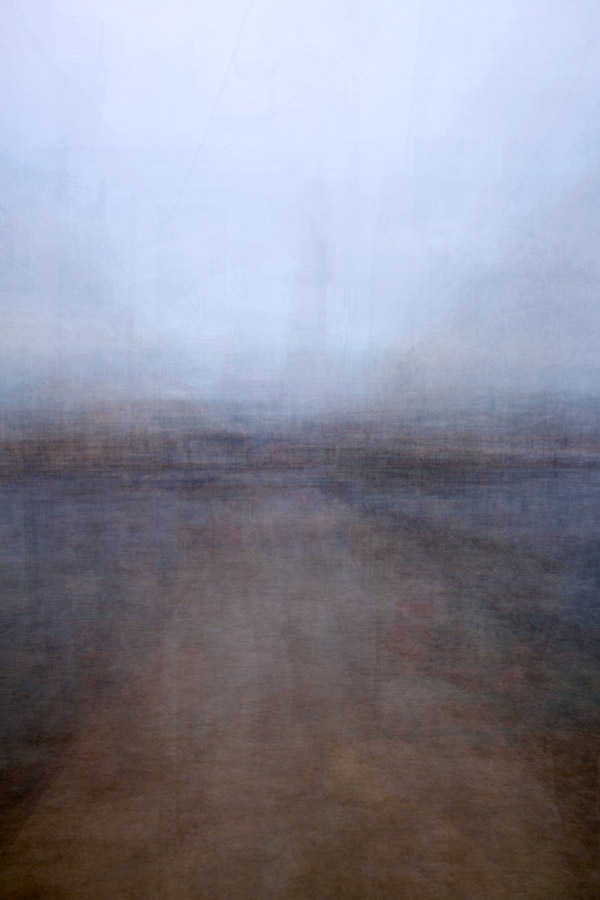
The technique behind these haunting images involved creating minute-by-minute photographs of the journey while maintaining a common horizon and vertical orientation. “Each work contains the visual content of roughly one hundred individual views that have been combined mathematically. The final image is the result of averaging the brightness and tone of these many photographs, pixel by pixel, into a single visual composite,” he wrote.
Brubaker said most photographers think in terms of one moment in time, one direction and one point of view. But his approach is to push many moments, directions and perspectives into one frame. The result is often abstract, dark, moody. “I’m trying to disrupt that one perspective, one angle, one moment, whether it’s camera-less cyanotypes or other methods or other things,” he said.
The road to Thomas
Brubaker’s long journey to Thomas could have been a work worthy of a thousand images. After graduation from Florida State, he paid the bills by running a small graphic design company that made websites. He moved to Brussels, where a friend lived, and earned his MFA from the Sint-Lukas School of Art. Thanks to his residency and Belgium’s education-focused climate, Brubaker’s MFA cost about $800.
His master’s thesis was Maps for Getting Lost, a series of photo books based on his exploratory journeys of Brussels. “They are an investigation of the process of travel without destination, or orientation,” he wrote on his website, jrbrubaker.com.
Brubaker briefly lived in Oakland, Calif., after his Brussels years, but a trip to Portland, Ore., changed his trajectory. “It wasn’t really until Portland when I started becoming more involved in photography. I met some really interesting people, other photographers, when I was out there,” he said.
In 2011, he visited a friend from Grand Rapids, Nathan Baker, who’d discovered Thomas as an ideal incubator for artists and their work. Brubaker sums up the town’s appeal in one word: space.
“In Portland, it didn’t seem like I could really do the things that I wanted to do, I couldn’t afford a studio space,” he said. “There really was not the possibility of starting a gallery with friends or to get in on anything from the ground up.”
East Avenue was still struggling at that time, and Brubaker, Nathan Baker, Seth Pitt and Kimberly Joy Trathen became partners in the studio and gallery space in what had been Jim Cooper’s Haberdashery. Initially known as the White Room, their space is now known as Invisible, an incubator and gallery shared among emerging and established artists.
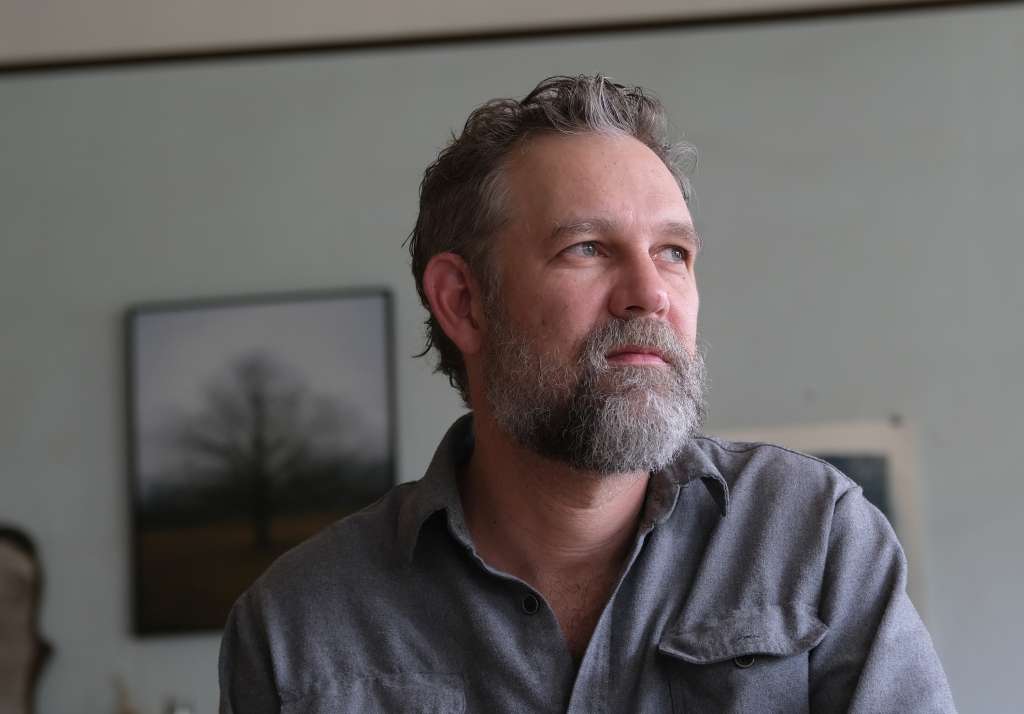
Many of the artists who landed in Thomas during those years earned living expenses working at the Purple Fiddle. Brubaker was an exception; he simply relocated his part-time graphic arts business. He said there’s never been a time in his fine arts career that art alone could pay the bills. Work for a non-profit in Brussels continues to provide Brubaker with the basics for his life in Thomas.
Nevertheless, Thomas nurtures on other levels, often invisible to the casual visitor. “One of the things about Thomas that is still special is that . . . there are spaces and events and things here that are not recorded, that you have to (live here) to experience,” he said. “There’s some stuff that we don’t publicize and there’s stuff that just happens spontaneously.”
Further, Thomas possesses a heritage that inspires artistic exploration, even for “a visual artist working mostly with experimental photographic processes.” While most photographers think in terms of a single moment in time, Brubaker’s perspective is much wider, which lends itself to drawing upon the region’s heritage of exploitation, specifically coal mining.
Brubaker’s first project to focus on that history was Slow Mining. Using pieces of coal he picked up on his walks around the community and on its trails, Brubaker made abstract paintings with the substance serving as both pigment and a three-dimensional clay of sorts. He ran the coal through a meat grinder and added it to acrylic medium for the paintings. His Sackler Treatment series used gelatin capsules filled with crushed coal to make statements about exploitation by both the coal industry and pharmaceuticals firms (Sackler Family/opioid crisis).
Coal’s legacy also appears in On Confluence, a series of works based upon Brubaker’s explorations of the North Branch of the Blackwater River that flows across the street from his apartment. The stream receives daily an estimated 2 million gallons of acid mine drainage from the legacy coal mines under Thomas. The water is so acidic it can act as photographic developer for the iron-based Van Dyke process.
“The process uses acidic water as its developing agent, making the contaminated portions of the North Fork an idea location for creating prints,” Brubaker writes on his website. “The works in this exhibition were processed directly in the river effected by acid mine drainage and have absorbed traces of the same heavy metals and mine runoff as the North Fork Watershed itself.”
Brubaker literally immersed himself in this project by wading the murky, brown water of the toxic stream as it makes its journey from Thomas to Douglas Falls. From poisoned water gushing from pipes to air bubbles on the stream’s surface, the images explore the river and its legacy. He exposed the paper using the sun and developed it in the acidic water in Long Run. Fixed in standard photo fixer, the prints were returned to the river for rinsing, then dried on the shore. The resulting prints are thus inorganic in their chemistry and organic in their composition.
More recently, Brubaker has been using another 19th-century photographic technique, cyanotypes (think “blueprints”), to make images of rain. That series, “Rain Pieces,” explores the microclimate of Tucker County using a combination of the Van Dyke and cyanotype processes.
“This chemistry is sensitive to water in sunlight, so you can put it out (during a rain event),” he said. “The water makes its impression; I finish it with the sunlight (or UV light) and rinse it. So, they’re really like one-of-a-kind records of the rain here. And, since I’ve started doing this, I have become really interested in this sort of microclimate that we have here and how it is changing. We’re essentially a temperate rain forest. Climate change is happening, and we can see it in all different ways.”
Brubaker estimates that he has made at least 200 of these records of Tucker County moisture events and yet each one is unique. As with his other one-of-a-kind print originals, he scans them in high resolution and prints them on a 40-inch-wide printer owned by the artists.
The rain portraits will comprise much of the exhibition on the first floor of the Aurora Project’s gallery, which was once a general store. The store’s original shelving was retained, and Brubaker said the horizontal surfaces will be his preferred way for exhibiting the Rain Pieces, face up toward the sky where their patterns originated.
“I think I am going to put a bunch of these out,” Brubaker said as he leafed through the 11-by-15 inch originals. “That makes sense, facing upward on all the shelves.”
He also plans to include pieces from the Ambient Geography series and perhaps a few examples of his artistry. All of his works require an understanding of the processes and premises in order to grasp the depth and ingenuity of Brubaker’s work. None of it is the breathtaking landscapes, misty sunrises and dramatic sunsets that draw most photographers to Tucker County. Brubaker’s studies are the prosaic; seeds bobbing on an acidic stream that offers little hope for life; raindrops that could have been the tears of a miner’s widow; collective memories of prosaic journeys.
“These pieces were made to serve as reminders that there is infinite potential in whatever course one chooses to pursue,” Brubaker states regarding his “Every Path is Viable” series. “And that at any moment, there are a multitude of paths available.”
Explore more of John Ryan Brubaker’s art at www.jrbrubaker.com and visiting the Invisible Gallery in Thomas.