
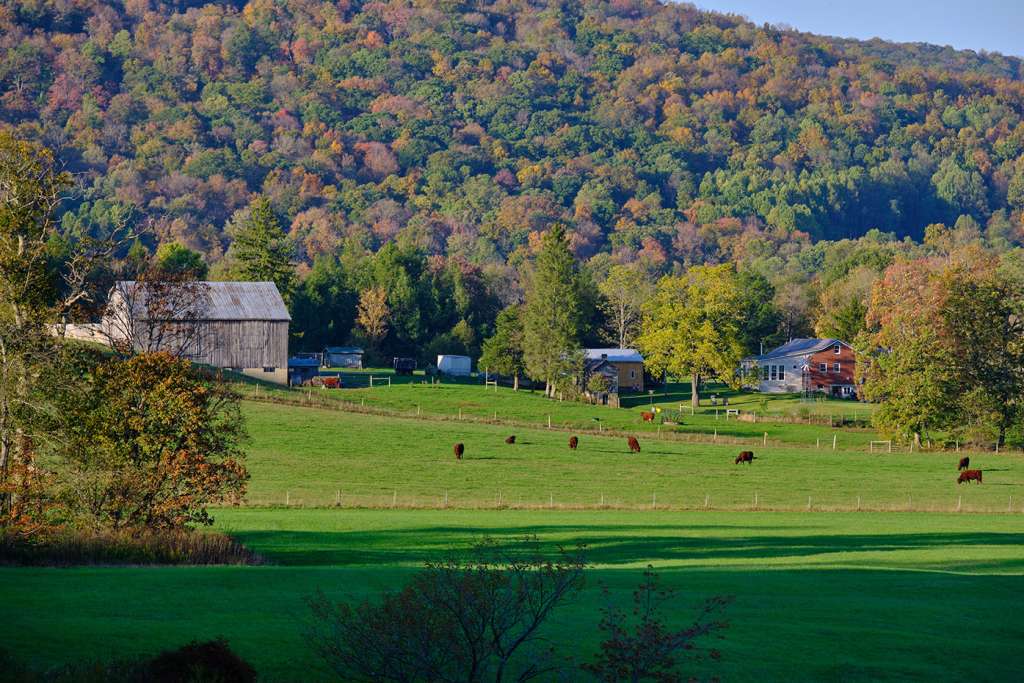
Aurora, situated on the summit of the Alleghenies in Preston County, WV, was founded by Rev. John Stough in 1787. In the next few years, he brought several Lutheran families from Hagerstown, Md., area. They established the first Lutheran settlement west of the Allegheny Mountains, and they named it Salem (later Mc. Carmel), German Settlement. That was changed to West Union, and finally, Aurora.
The town was set up as a planned community with lots being sold as early as 1827.
The Northwest Turnpike, aka George Washington Highway and Route 50, reached Parkersburg by 1838. Its path was a half mile south of Mt. Carmel. Accordingly, West Union on the turnpike grew while Mt. Carmel decreased in prominence. The towns merged as Aurora in 1875.
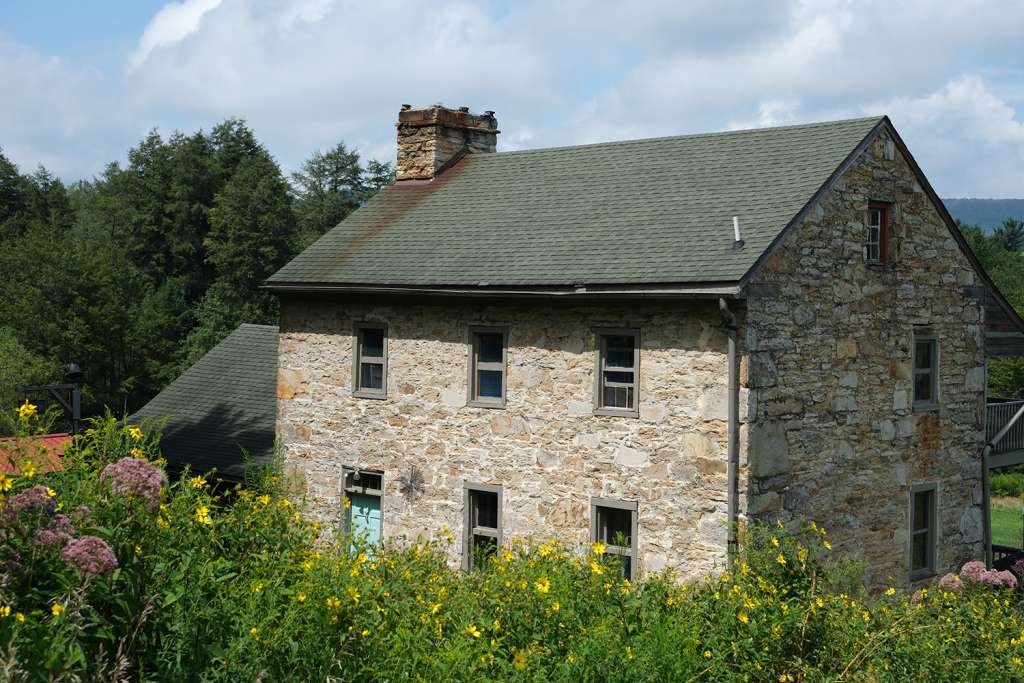
The turnpike generated opportunity for traveler services. The Red Horse Tavern, which still stands, was raised one mile east of Aurora in 1827. Originally built as a home for Henry Grimes, it was opened as a tavern in 1841 by George C. Hauser, Hiram Henshaw and William H. Grimes. It is on the National Register of Historic Places.
The primary occupation of Aurora residents has always been farming. Most of the small farms raised buckwheat and other grains, sheep, cattle and hogs. Most of what they grew was consumed by the family.
Grain farming required the services of a mill. The first one was built at the falls of Wolf Creek on what is Fox Road. Rev. John Sough built it in 1790. Its capacity was just three bushels of corn daily. More efficient mills came along thereafter at Brookside by Nicholas Wotring. It operated until 1842.
Logging grew in economic significance in the late 1890s. A logging road from Crellin, Md., to Aurora was built over Shafer Mountain and down the north branch of Rhine Creek to what is now Cathedral State Park. Using large sled, logs were hauled from Stemple Ridge, Lantz Ridge, Mountain Top and the upper parts of Little Wolf Creek in winter.
Meanwhile, the Kendall Lumber Company floated their logs on the Youghiogheny River when water levels permitted. A dam was constructed at Silver Lake for this operation.
Hospitality was a significant economic engine for Aurora, as well. The high elevation and healthful atmosphere provided relief from the heat of Baltimore and other eastern cities. The Baltimore & Ohio Railroad brought passengers as far as Oakland, Md., where they transferred to horse-drawn conveyances to Aurora. Each hotel had its own carriage, and later automobiles, for transferring guests from the rail station to Aurora.
In 1884, the Brookside Hotel and Cottages were built by Judge Vail of Harpers Ferry. It stood on the north side of the highway; only a stone wall remains of the resort, which was very advanced for its rural location. It even had its own lighting system fueled by an acetylene plant on the properties. Lede McBride of Cleveland purchased it in 1894 and greatly enlarged the resort with a casino/billiard room, concert and dance hall, and kitchen and dining room. Several wooden cottages offering from five to 22 rooms and 1 to 5 bathrooms, as well as running hot and cold water, were offered. A separate building provided a nursery for the children who often stayed the entire summer with their mothers.
These cottages had oriental rugs, flowered wallpaper, heavy furniture and some twig furniture and accessories. Their large front porches had rocking chairs and a view of the mountain. Gaymont was the finest of these cottages. McBride built it for his wife, who was an invalid. Modeled after the Swiss chalet where the couple had spent their honeymoon, Gaymont featured a 16-foot-deep porch that wraps around three sides of the building. A master carpenter from Maine spent two years building the doors, window frames, and installing heavy oak paneling for wainscoting. The firsts floor exterior is built from hemlock logs harvested from the property. It still stands, along with several of the cottages, all owned by the Aurora Project.
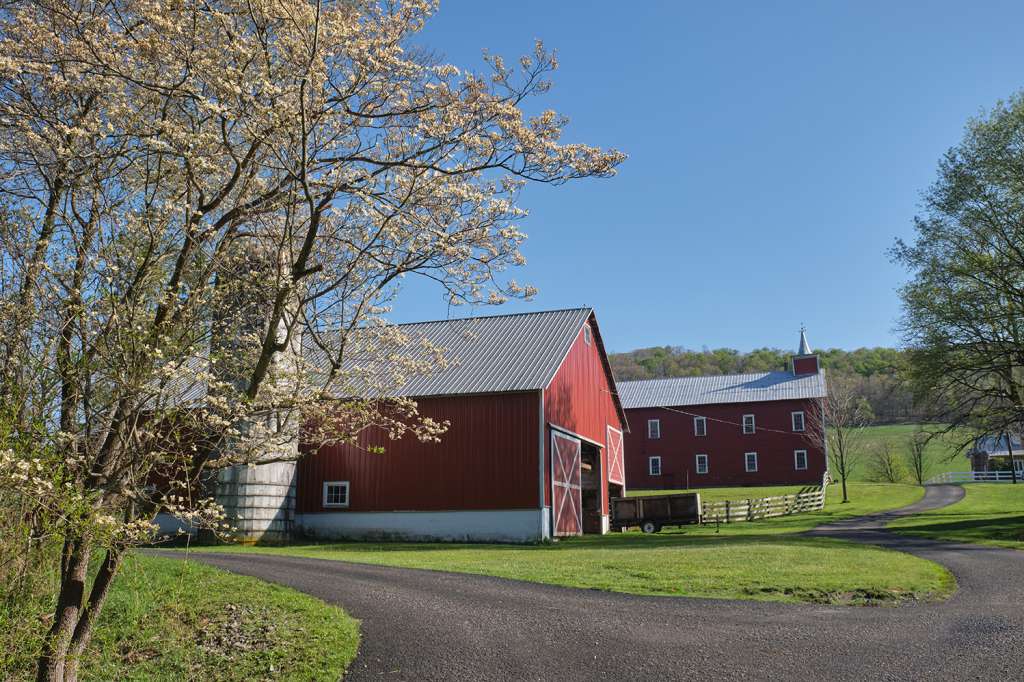
The McBrides also built Brookside Farm on Rhine Creek, behind the Brookside Hotel. The farm provided vegetables, meat, eggs and dairy to guests. Still a working farm, Brookside is used by Jacob’s Ladder, as are Gaymont and several of the original cottages.
Brookside was just one of the resorts at Aurora, which at its peak had lodging for hundreds of guests. Other hospitality businesses included The Aurora House Hotel, where workers who paved Route 50 in the 1920s stayed. They were the last guests, and the hotel was torn down in the 1940s.
The Mountain View Hotel operated until the 1960s, when it was dismantled. The hotel had a beautiful central stairway that went up three floors; employees slept on the top floor. In the off season, the hotel’s second floor was used as a temporary hospital ward for a physician who removed the tonsils of Aurora area children!
Aurora had a Greyhound bus stop for many years, as well as several restaurants and service stations. The Royal Cafe was operated by Dayton and Lorraine Teets. It had a long counter with stools, as well as several tables. Hattie Hass opened her home to diners during the summer months; she was known for her chicken dinners. E.C. Stemple and his wife Laura and their daughter, Marion, operated the Four Winds Tea Room in the early 1930s.
Cheat Mountain is to the west of Aurora. The long, steep, curvy mountain challenged motor vehicles and exposed their vulnerabilities. Accordingly, there were several service stations along Route 50 in Aurora. George Lipscomb was one of the garage owners and was called upon to tow disabled vehicles up the mountain to his Mt. Top Garage (1931-about 1970). George’s tourist services included an observation tower with a telescope in it!

As Brookside Hotel began phasing out operation in the early 1920s, Mr. Branson Haas purchased the 133 acres of hemlock trees. In 1942, he sold the forest to the state with the provision it would remain untouched by ax or saw. He remained as caretaker until his death in 1955. It was then named Cathedral State Park and in 1966 entered in the National Registry for Natural Landmarks. It is the only stand of mixed virgin timber in West Virginia.
The alpine environment of the Youghiogheny Forest east of Aurora became home to a forest colony of intellectuals during The Great Depression. Frank Reeves, a geologist, invited artists, sculptors, musicians and writers from eastern cities to spend their summers in the 15 cottages built from dying chestnut trees on the 100 acres he owned. Jobs were limited, and the intellectuals came to Aurora to “sit out The Depression.” Their gathering spot was Reeves’ tavern along Route 50. Living was cheap yet abundant, thanks to farms, game and fishing in the community.
Intellectuals in the group included:
- Felix Robinson, author and editor of Tableland Trails. A Lutheran pastor from Oakland, he founded the Mountain Choir Festival in 1934.
- Arvid Kundzin, a former diplomat from Latvia, and Eric Menke, both architects. Menke was instrumental in bringing a young German student, Volkmar Wentzel, to the colony. Mr. Wentzel completed his high school education at Aurora, then went on to career as a photographer for National Geographic. He and his wife, Viola, were co-founders of The Aurora Project.
- Joe Goethe, an eccentric wood carver-sculptor;
- Thomas Hood, a watercolorist;
- Bob Gates, who painted the Oakland Post Office mural;
- Dennis and Iva Hobdin, musicians who gave concerts in the tavern;
- Drs. Philip and Velda Graven, D.C. psychiatrists who had been trained in Vienna. They brought their two Rolls Royce automobiles to Aurora during The Depression!
- Lewis Stemple was a local artist who was influenced by this stimulating group. Many of his paintings are owned by Aurora residents, who loaned them to The Aurora Project for a 25th anniversary exhibition (September 2026).
From the book, Aurora, WV in the Twentieth Century, compiled by Alice McGinnis Penzo and Laura Lee Frye