
Legacy: Volkmar Wentzel
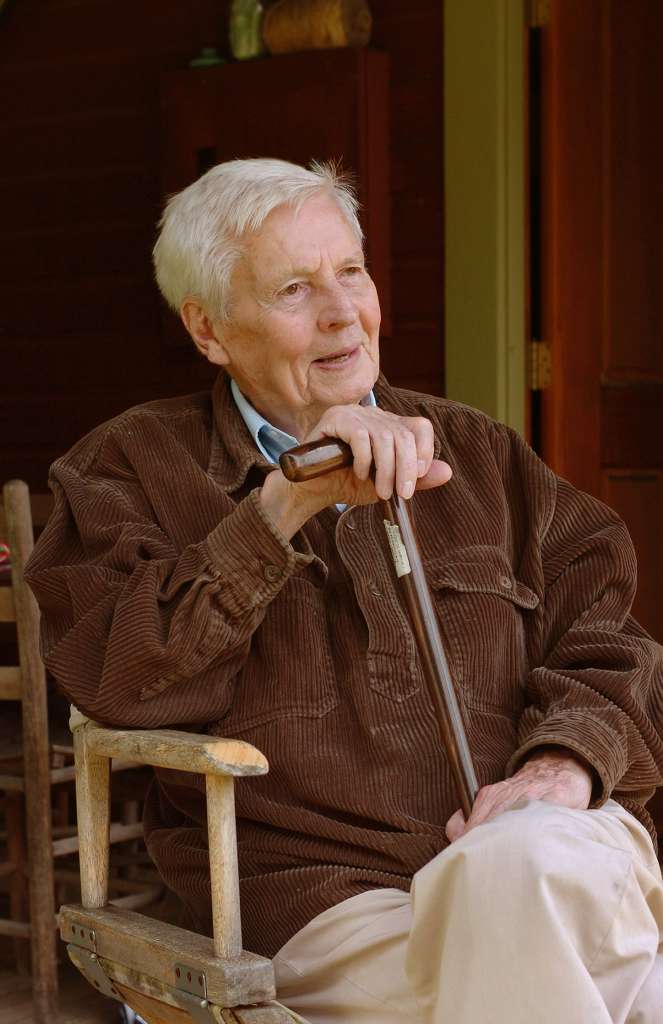
By Carl E. Feather
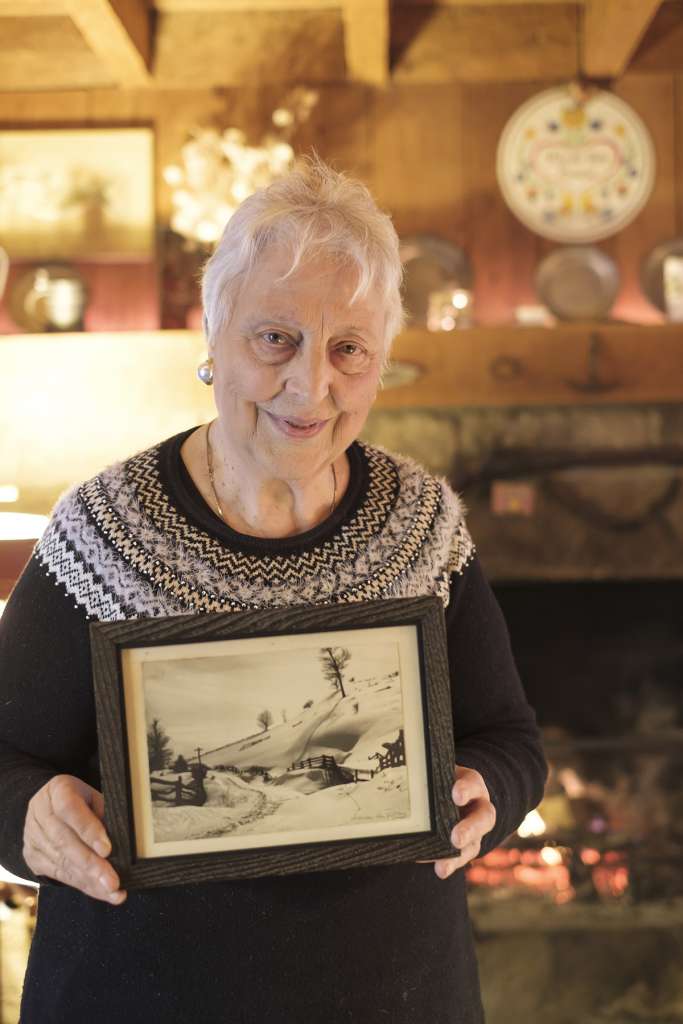
Go down the Shoemaker-Cole Road, that dusty byway that links Aurora to Eglon, West Virginia to Germany. Pause at that point amid hemlocks and rail fence, where the single lane curves uphill and leftward, where narrow shadow of a lone oak tree descends yonder hillside. On this winter afternoon in 1935, the moment is perfect for a photograph.
Volkmar Kurt Wentzel, 20, raises his Voigtlander camera, peers into its ground glass and composes therein the pertinent elements. The shutter blinks, exposing the 6-by-9 centimeters piece of black-and-white film that his father, Fritz Gustav Wentzel, possibly had a hand in formulating. That night, in a chilly pumphouse on the opposite side of the Northwestern Turnpike, Volkmar successively immerses the film in developer, stop bath and fixer, then washes the processed negative in spring water.
A print struck from the negative hangs in the dining room of the Aurora house that Volkmar and his wife Viola designed. Built by Terra Alta carpenter Elmer Strawser, the house stands on the 13.5-acre parcel purchased by Volkmar in March 1937 from Mr. and Mrs. Roy Teets of Eglon. His high school graduation gift of $135 from his father funded the investment.
“I helped survey this parcel of land and was struck by the beauty of this piece of unique mountain forest—the swiftly winding stream, the stately hemlock trees, the abundant ferns and rhododendrons,” Volkmar stated in correspondence with me in September 2004. “Simply, I fell in love with the place.”
Nearly 80 years after Volkmar fell in love with this place, on a rainy morning in late October 2021, Viola Wentzel welcomes me into the rustic residence. It is thousands of miles from Viola’s native Germany, yet as close as she can get to that familiar landscape without crossing the Atlantic.
“I came here because it looked exactly like home,” Viola tells me. “My children (who have been to Germany) say it looks like West Virginia there. The geography is pretty much the same.”
This refrain of Aurora’s landscape mirroring that of southwest Germany runs throughout Aurora’s heritage like the Rhine and Wolf creeks that duck in and out of the rhododendron thickets. The German Palatinate, located west of the Rhine River, supplied the majority of the immigrants who possessed the knowledge, grit and motivation to transform hemlock forest into farms and community.
Gottfried Stough arrived in Philadelphia from Germany on Sept. 27, 1752. He and Charlotte Kessler married Dec. 25, 1754, and seven years and one month later welcomed their son, John, into this world. John, a Lutheran, studied for the ministry and became a missionary to the western wilderness of Virginia and Maryland. After a journey full of hardships and tragedy, he and three others followed an Indian trial into the Youghiogheny tableland. Their stop was intended to be a respite, but Stough liked it so much he decided to settle in the clearing that he named “Salem,” Hebrew for “peaceful.” Other Germans from the Susquehanna River Valley and Hagerstown soon thereafter made the treacherous journey to what would become Mount Carmel, and finally, Aurora.
The records of Aurora’s St. Paul Lutheran Church are saturated with the surnames names of hardy German immigrants: Heid, Stembel, Heckerd, Wudring, Reidenauer, Bischof, Neil, Wile, Shafer, Stertzman, Heinrich … and my maternal great-grandmother’s family, Hirsch (Harsh).
The story of how the Wentzel name also became woven into the fabric of the Aurora Community is one of fortuitous serendipity for both the characters and community. It begins in Binghamton, N.Y., in 1934, when Volkmar and a friend set out for Rio, on what they called a “Good Will Tour.” Eight years earlier, Volkmar’s parents and their four sons emigrated to escape the massive unemployment, financial hardships and political turmoil that plagued Germany after World War I. Volkmar’s father, Fritz Gustav, was a photo-chemist who held doctorates in chemistry and engineering, which qualified him for the position of director at the Ansco photographic paper plant in Binghamton.
Relief from the hardships of Germany were short-lived as Volkmar’s mother died in 1932. “This was a terrible blow for my father, now alone with four teenage boys to take care of, along with his demanding job and the writing of several books,” Volkmar told me in correspondence.
By February 1935, the situation at home “became quite impossible,” and Volkmar and a friend, Bill Buckley, decided to sell all their boyhood artifacts, hike to Brazil and promote “good will” along the trek. Outfitted with khaki shorts, riding britches and tall boots to protect them against jungle snakes, the young men departed Binghamton wearing backpacks bearing “New York to Rio” in 3-inch red letters.
Three days of hitchhiking got them as far as Washington, D.C., where the cold, hungry and tired explorers parted ways after a miserable night in a flophouse. “I soon fell asleep and when I awoke, I heard Bill pounding away at something with his high-top boots,” Volkmar wrote. Bill declared, “This place is full of cockroaches” as he squashed the “southern-style” roaches that came in a 3-inch size. His mind infested with the memory of the cockroaches, Bill decided the next morning to go home to his mother. Standing in front of the old State and War Department building, the adventurers divided their finances, leaving Volkmar with $70. He never heard from Bill again.
Volkmar ditched his backpack and lined up in front of the newspaper’s window to read Washington Post classified ads, in which he found a room at 716 Jackson Place, NW, on Lafayette Square. New Deal lawyer Tommy “the Cork” Corcoran had his law office on the first floor; the second-level tenants provided Volkmar with the link to Aurora. During The Depression work was difficult to find and intermittent for many writers and artists. Several of those involved in the new Municipal Center construction project in D.C. decided to sit out their furlough time in the Youghiogheny Forest in southeastern Preston County. “The countryside remined them of home,” Volkmar said, referring to the artists’ eastern European roots. “Through Eric Menke I met this group, who offered me a job for $2.50 per week to take care of their small studios and piece of property.” And that is how Volkmar Wentzel came to Aurora.
“Driving up there at the time was usually with Arved Kundzin in his Buick Roadster via Winchester, Va., and Romney, W.Va., and along U.S. Route 50 that was, in places, still a simple, unpaved dirt road. “It was exciting to drive up the so-called Allegheny Front, very curvy and quite steep. Cars often had to stop to cool the boiling water in their radiators,” he wrote to me in 2004.
“Entering Appalachia, where I had never been before, was a wonderful eye opener. Going over one range of mountains after another, I got to respect highly the pioneers who first crossed this rugged terrain with their families in horse-drawn Conestoga wagons.
“The first night I spent in the Youghiogheny Forest was in a log cabin tavern, right along US 50, a kind of bed and breakfast place that had been built by Frank Reeves, a distinguished geologist and noted worldwide oil explorer. It was operated by his German wife, Lottie,” he concluded.
The community consisted of this tavern, a log-cabin lodge in the forest and several studio buildings “They were of various styles and sizes, with some Bauhaus influence here and there,” he told me in a 2004 interview. “They served the purpose of the artists of writers who occupied them.”
Because many of these cheaply made structures had interior walls of Celotex, a composition board made of sugar cane residue, the community became known as “Celotex Hill.” Volkmar was right at home in both landscape and human company. Menke was born in Frankfurt, Germany, and educated in architecture at Yale. He was working as Municipal Center architect. “He was very erudite with a somewhat explosive temperament,” Volkmar recalled. “His universal mind delved into everything.”
Kundzin, driver of that Buick Roadster, was a former diplomat from a distinguished family in Riga, Latvia. A competent wood carver, he painted forest scenes in oil and loved classical music, particularly that of Jan Sibelius. Other members of this artists community at Aurora included:
- Robert Gates and his wife, Margaret. He was an accomplished artist who did the WPA mural in the Oakland, Maryland, Post Office. Some of his work is in the Phillips Collection, Washington, D.C.
- Victor, Patsy and Irene Givitovsky comprised a family of Russians who had escaped through Vladivostok. He was a prominent engineer on the Municipal Center project; his wife was an excellent cook, and their daughter, Irene, was “strikingly beautiful” and Volkmar’s “secret passion,” he said. “A great family.”
- Dr. David Lindsay Watson. Highly educated, the Scotland native was using his time at Youghiogheny to write his classic, Scientists are Human, published in 1938. Volkmar stated that Watson used his familiarity with all the great scientists, philosophers and literary people as source material for the book. “Helmholtz, Prinzhorn, Thoreau, Spengler, Einstein, Bertrand Russell and the like were all familiar to him and inspiring to me,” Volkmar recalled.
- Velda and Sigurd Graven. In that era, Graven was considered the most outstanding psychiatrist in the Capitol and his client list included Siam’s king. His wife possessed great knowledge of mushrooms and “knew how to cook them in a most delicious way.” Blessed with the finances that many of the Aurora artists lacked, the Gravens built a beautiful log cabin featuring large fireplaces, glass-brick illumination and an Austrian touch of comfort.
- The Hobdens. This English couple often entertained the colony’s inhabitants with their music.
Surrounded by this international cast of thinkers and artists, as well as the rugged landscape reminiscent of Germany, Volkmar embraced his Appalachian “Rio.” But he soon discovered that he could not exist on a $2.50 weekly salary. Rather than give him a raise, Menke suggested Volkmar make extra money taking and seller photographs with the Voiglander camera that his father had gifted him.
An old pumphouse built by Reeves was re-purposed as a darkroom; Volkmar obtained the film, chemicals, and other supplies he needed to develop and print his film in nearby Oakland.
“I’d have to wait until some of the Washington people would come up so I’d have a way to get to Oakland,” he told me in a 2004 interview. “Or, if (Aurora residents) Gene and Bessie Shoemaker were going into town with their produce, I’d ride with them in their horse and carriage.”
The pump house had no electrical service; because of multiple light leaks, he was forced to work at night. Viola says Volkmar was fond of telling the story of reaching into the rafters of the building and grabbing something hanging from the ceiling—that something was one of the black snakes common in this forest!
Volkmar turned his lens toward the landscape, from the mushrooms and ferns of the forest floor to the mountain peaks dotted with livestock. He printed postcards of these scenes and sold them in the Reeves’ tavern. He also did portraits of Eglon and Aurora farm families and their children. Like Volkmar, they were strapped for cash and bartered produce for prints.
“I’d get a bushel of potatoes and some onions, and I’d live for weeks on end on potato soup,” he told me in a 2004 interview. “I traded buckwheat flour, maple syrup, potatoes and eggs, and that’s how I survived. The people there were terribly nice to me.”
A sale of three landscape postcards was the turning point in his status from amateur to professional photographer. The buyer was Eleanor Roosevelt, who was enroute to her pet New Deal project, Arthurdale, in Preston County. While Volkmar was not at the tavern to witness the sale or meet the First Lady, her simple act encouraged him to pursue a career in photography.
“It was a real ego booster,” he told me. “I decided to go back to D.C. and see if I could get a job with a photography outfit.”
Although he had attended classes at Aurora High School, Volkmar was still short of the education he needed to get a high school diploma when he went to D.C. and applied for a darkroom technician’s job at Underwood and Underwood Portrait Studios and News Agency. “My little bit of West Virginia darkroom experience all of sudden was important,” he said. The job, which paid $12.50 a week, involved mixing large crocks of photographic developers and fixer. He labored in the basement, “a hell-hole of a place. It was a sweatshop,” he said.
Clarence Jackson, a news photographer at Underwood and Underwood, took Volkmar under his wing and gave him the opportunity to shoot with old Speed Graphic cameras. His assignment was a series of portraits of the French ambassador’s wife as she descended the French Embassy steps. He recorded two images, one of which was selected for publication in the rotogravure society section of the Sunday Washington Star.
Impressed with Volkmar’s work behind the lens, his employer provided Volkmar with a worn Speed Graphic camera and Crown tripod to hone his craft. Confined to the darkroom by day, Volkmar was largely limited to nighttime photography. Menke presented Volkmar with a copy of Paris de Nuit by French photographer Brassai. The images inspired him to turn the old camera on Washington’s buildings.
“I was enchanted by the ethereal images revealed by the witchery of the night,” Volkmar wrote in the preface to his book, Washington by Night. “Floodlights etched familiar landmarks against the velvet sky. The Capitol, the Washington Monument, and the Lincoln Memorial glowed as if from within. I made many pictures in the heavy atmosphere of damp and foggy nights, when diffused light reduces scenes to their simplest elements.”
After walking the city by night, making trial-and-error exposures, Volkmar developed his negatives at Underwood and Underwood. He printed a few of them on the studio’s best portrait paper and submitted them to the Royal Photographic Society of Great Britain in 1936. When the prints were returned to him later that year, several bore gold-prize stickers. On a whim, while walking back to his garret from the post office, the prints under an arm, Volkmar stopped by the offices of the National Geographic Society and asked for a tour. His request granted, Volkmar was stricken with envy.
“I thought, ‘If I could just wipe the floor here, I’d be happy,’” he said. In yet another stroke of good fortune that fateful day, the employee told Volkmar he was planning to leave his job and there would be an opening. Volkmar made the society’s personnel office his last stop, where he ran into a brick wall, aka “personnel director.”
“She said, ‘We only take very highly qualified people,’” Volkmar recalled. “I was already at the door, ready to leave, when I remembered the package of pictures under my arm and asked if she would like to look at them. She wasn’t so much interested in the pictures as she was the golden stickers from where they had hung in the salons of Europe.”
He was interviewed and offered a photo lab position, to which he reported January 2, 1937. “It was a dream come true for me,” he recalled. “I couldn’t get there early enough in the morning. I loved it so much.”
A few months into the job, serendipity smiled on him again. Photographer B. Anthony Stewart, who had been illustrating a story about West Virginia, was reassigned to Europe. Volkmar, familiar with the state from having lived in Aurora, was given the assignment of completing Mountain State photography. “The first place I went back to was (Aurora), because I knew the area,” he said.
Among his images that were published in the August 1940 issue of National Geographic is “Stemple Ridge folk,” a group of ladies working their names into a friendship quilt, a gift for a departing neighbor. Carefully posed, yet coming across as spontaneous, the image was captured on cut-sheet Kodachrome film and lighted with incandescent photofloods. The quilt that the women were working on is owned by the Aurora Historical Society and displayed in its museum, along with the names of those in the images and other quilting memorabilia from the community.
From Stemple Ridge, Volkmar traveled to Seneca Rocks, the china and glassware factories of the northern panhandle, a Richwood clothespin factory, Wheeling steel mills and a gas well in Charleston. The state and its people left a lifelong impression on the young photographer.
Years later Viola would write of his love for the state in Odysseys and Photographs: Four National Geographic Field Men.
“He loved its windswept highlands and deep valleys. He photographed farmers, miners, quilting parties, applesauce-making, quaint traditions, hardship, courage, and poverty,” she wrote. “Here began a lifelong love affair with this beautiful mountain state and its people.”
“The more I saw of it, the more I loved the country and its people,” Volkmar told me in 2004.
During his career with NGS, Volkmar was photographer for nearly three dozen stories and wrote and photographed 10 stories, including “Washington, D.C.: The Nation’s Capital by Night” (April 1940) and “History Awakens at Harpers Ferry (March 1957). He served in the photographic division of the Army Air Corps during World War II, and when he returned to the NGS, his editor sent him a telegraph with a two-word assignment: “Do India.”
It was on that assignment that his ingenuity, curiosity, craftsmanship and artistry were both taxed and revealed. He carried 18 suitcases of equipment across the subcontinent and transitioning nation. His transportation was an old, hand-cranked war ambulance purchased for $600. He had the words “National Geographic Photo Survey of India” painted on the side in English, Urdu and Hindi. Volkmar knew the value of being able to attract a crowd and eventually put them at ease in front of a camera.
With his fair blond hair, pitch-black eyes and dimples that appeared with each smile, he also attracted Viola. They first met over lunch at the German Embassy, Washington, D.C., in 1963. She was on her third day in the states, having come to D.C. to study at Georgetown University. A friend introduced them and shared little in way of background about Volkmar—or her family: her father was West German Chancellor Kurt George Kiesinger. “I didn’t know he spoke German,” she says. “I had studied in England, so my English was pretty good. On our second date, I found out he spoke German.”
As she got to know this man who was more than 25 years her senior, she learned that he had met her father in 1949 while on assignment and when Kiesinger was a member of parliament. She also learned about his property in Aurora. “He always said, ‘I have a piece of land that looks very much like where you lived in Germany,’” Viola says.
She first saw it during an early fall blizzard. “We walked down a narrow lane off Route 50 to Bessie’s and Jean’s Shoemakers farm, where Volkmar had stayed often as a teenager. The stormy sky had opened a little, and blue, long shadows lay on the snow-covered fields. A lonely wind-swept oak watched the valley below, a single narrow path of human footsteps wound its way through the drifts. I knew I had come home. This is where I belonged,” she wrote in a memoir.
Even the culture was familiar to Viola; despite her father’s position in the government, the family was forced to move from village to village during World War II in order to escape Allied attacks on the industrial centers. “I was born in Berlin, says Viola, born in 1940. “When the bombs started falling really seriously, we moved from Berlin to the countryside. We moved about 12 times, from one little village to another,” she says. “ … so, coming to Aurora was not a culture shock at all. I grew up during the war; we’d have electricity only two hours a day, even after the war. My way of growing up was a little bit like the Amish, not in the religious way, but what you had was what you had.”
The man who introduced Viola and Volkmar had told her that he was 37 years old, and she had no reason to doubt that because “he looked very young.” Prior to proposing, Volkmar revealed the significant age difference. “He said, ‘I would like to marry you, but I have to tell you, I am actually 48, not 37,’” she recalls.
They were married in a civil ceremony in Washington, D.C., on March 4, 1964. From there, Viola rushed off to Germany, where the church wedding was held April 8. It was a huge event, with a who’s who of West German government officials attending.
Back in Washington, D.C., the couple settled into married life with the caveat of Volkmar being away for long periods while he worked on NGS assignments. “I wasn’t that thrilled about it,” Viola admits, but she and their three children made the best of it. And the entire family looked forward to their respites in the Youghiogheny forest. In October 1972 Elmer Strawser began work on their farmhouse. He used wormy chestnut from old barns, native stone and hewn beams to create the house that resembles the barn-inspired design envisioned by its owners.
Viola says they had just purchased a house in Washington, D.C., and were “penniless” when they borrowed money for the Aurora construction project. To make payments on the debt, Viola started a business, although she didn’t foresee it as such. She wanted to travel back to Germany, but lacked funds for the airfare, more than $600. She got the idea of chartering a plane and selling the other 249 seats on it to her D.C. acquaintances. She charged $183 a seat and made $3 off each one. “I didn’t do it as a business but because I needed to go home cheaply,” she says.
She reminds me that in Washington D.C., there were 25,000 Germans at the time her father was chancellor. And these people felt “who else can you trust with your money” if you can’t trust the daughter of the chancellor? Thus, Viola, who had majored in poetry, became a business owner. Incorporated as Atlantic Fellowship, she chartered hundreds planes under the club’s name and owned the business until selling it in 2008.
Both she and Volkmar were heavily invested in their Washington, D.C., connections and could not abandon the city for their home in Aurora. Nevertheless, they continued to acquire land along Shoemaker Road as it became available. That included a purchase of the Shoemaker farm and its farmhouse, which was built in 1868 and suffering from years of neglect.
“Though everyone recommended we tear it down, we decided to renovate,” Volkmar said in the 2004 interview with me. “It took us four years to restore the place, dig out a caved-in dirt basement, to install electricity and running water, and to bring it back to the charm of a Victorian farmhouse.” They also purchased the Gnegy farmhouse and restored it. In all, there are more than 90 acres of farmland and forest in their Aurora holdings. Some of it is devoted to cattle farming, all of it is a favorite destination for the three children and eight grandchildren who return often—each child has a house they can use during their visits. Viola’s father visited Aurora in the summer for 16 years and felt right at home in the landscape.
The Aurora property finally became Viola’s primary residence in 2013, when she sold out in Washington. She is involved in the community and is treasurer of the Aurora Project, of which she served as president for 12 years. Her son, Dr. Peter Wentzel and his wife, Mary Gainer, live in Morgantown; he has a practice in Grafton, she in Rowlesburg and Newburg.
“My son is here almost every weekend,” she says. “He grew up with all the local boys here, so when I need help, they know who I am when I call and say ‘This is Peter’s mom.’”
Their daughters, Ceclia and Christina, live in New York, are degreed in medicine and visit the farm frequently. All three children reflect the mantra of their father, who did not obtain a college degree but was “very well read,” says Viola. “He’d drive the children to school in the morning, and he always reminded them ‘knowledge is power.”
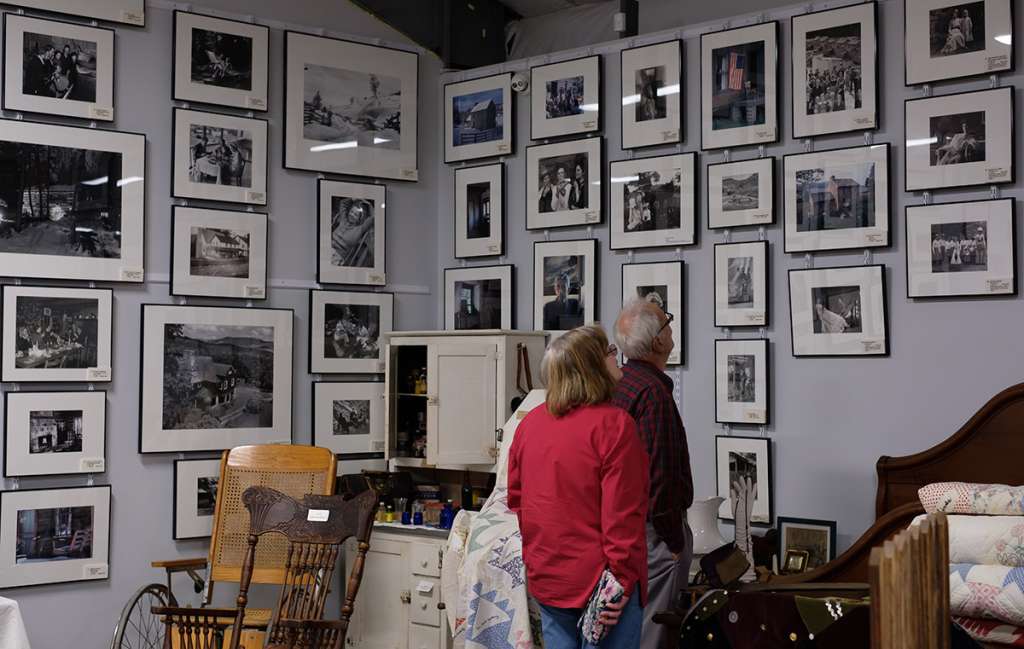
Volkmar retired from the NGS after 48 years of service but remained involved in photography, including documenting the landscape and people of West Virginia. He made prints of many of his captures from the 1930s and they can be viewed, along with more recent work, at the Aurora Historical Society’s museum on Route 50. His darkroom is housed in Aurora’s former general store building, operated as part of the Aurora Project.
One of his greatest achievements occurred following retirement—rescuing and creating a framework for the preservation of thousands of negatives and slides from the early days of the NGS. In her biography of Volkmar, published in Odysseys and Photographs, Viola recounts how he rescued some 3,000 negatives and a few other rare originals that the NGS had culled as part of its Project Negative. That led to the establishment of the Melville Bell Grosvenor Image Library to preserve the NGS photographic assets; he was the society’s first archivist.
“Shortly before his death Volkmar told me, ‘I don’t want to be known for my photography but for my efforts to preserve the National Geographic archive that documented our changing world for nearly a hundred years,’” Viola wrote in Odysseys and Photographs. “My husband was a modest man, and I was a very lucky wife.”
The collection of Volkmar’s personal work, which is not controlled by the NGS, is held by the family. Consisting of more than 30,000 images, the collection is protected in a climate-controlled facility. A small sampling of his work is online at https://volkmarkurtwentzel.com
Volkmar Wentzel died in May 2006, from a blood clot resulting from a broken leg sustained from a fall in his Washington home. His passing was marked by the major media, but the formal obituaries missed the serendipity of this amazing life and the German-born man who loved and adopted West Virginia as his homeland. In our interview in 2004, he wrapped it up this way: “It all worked out just fine, thanks to that German architect. He steered me right.”