
Adapted from “Wandering U.S. 50 in West Virginia,” by Carl E. Feather
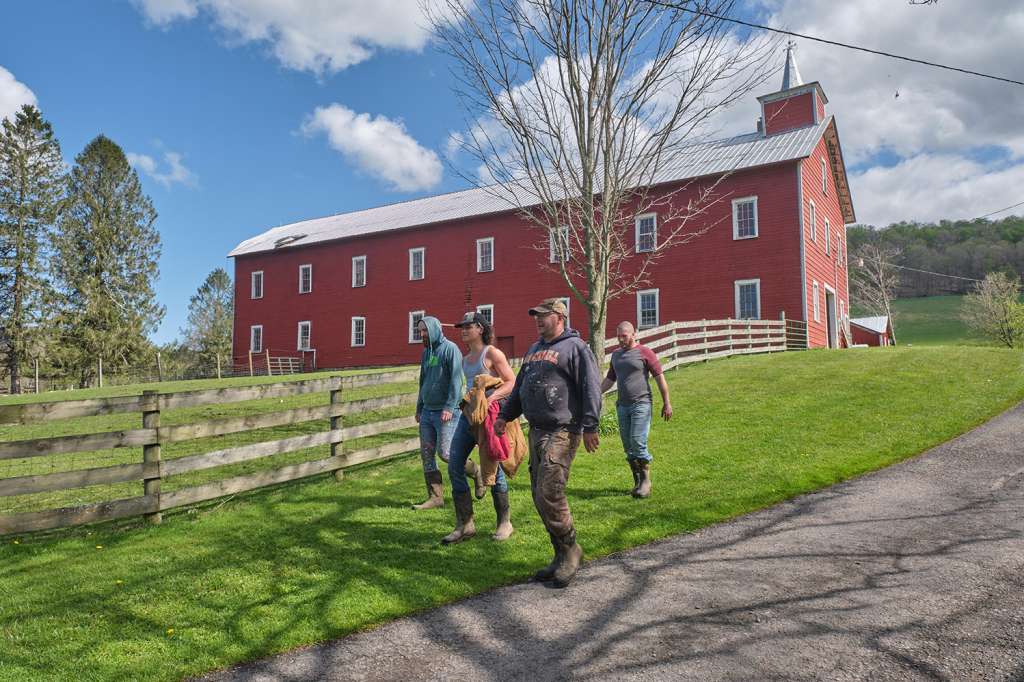
The three-mile, 28-curve climb on US Route 50 from Erwin to Aurora is arduous in good weather; in bad, it is downright treacherous. But the bucolic Aurora scenery is worth the exhausting climb. Foremost is the ancient Cathedral Woods, a hemlock climax forest. The forest wraps around Brookside Farm, a piece of misplaced New England agriculture with its assortment of red barns and sheds, stone house, and verdant hillside pastures.
More than a century ago, city folks came from sweltering East Coast cities on the Baltimore and Ohio Railroad to be fanned by the breezes that blow across porched cottages set along the hill across from Brookside. Thrice daily, vacationers’ tables at this resort were set with protein and vegetables from the farm; from first light to gloaming, the hemlock sanctuary invited awestruck worshippers to ascend its ladders of majestic consciousness.
While the tourists are long gone, several of the cottages, the forest, and most of the farm remain. Collectively, they provide the setting and residences for Jacob’s Ladder. On any given day, twelve men labor on this mountain, ascending ladders of twelve rungs out of the pit of substance abuse. As with the highway ascent to this place, the way is steep, arduous, and, at times, treacherous. Indeed, the lives and futures of these twelve men dangle from these rungs, customized to assist the climber attain a life of sustained recovery and freedom from their demons.
“It’s a residential treatment that shows you, more than anything else, how to work for yourself,” says Aidan, an 18-year-old from Mississippi and Jacob’s Ladder graduate. “That’s the biggest thing I’ve gained out of here. I think the backbone behind everything is teaching us that if we want it, we have to go out and get it for ourselves. It’s a great program and it’s changed the course of my life.”
This melding of working farm, natural area, repurposed resort, and treatment program was the first of its kind for West Virginia when it opened on March 15, 2015. Licensed by the West Virginia State Board of Behavioral Health, Jacob’s Ladder accepts private pay, as well as government and private insurances. Participants live a monastic lifestyle for six months, with no access to social media and only 30-minutes of family contact time per week.
Neither the Jacob nor the ladder has spiritual moorings; rather, the ladder represents the Twelve Steps of Narcotics Anonymous, one of several approaches used at the residential treatment center. The Jacob comes from the program’s inspiration, Jacob Blankenship. Chad Bishop, director of operations for Jacob’s Ladder, says the program was born of personal experience—the founder, Dr. Kevin Blankenship, needed drug addiction treatment for the family member but could not find long-term residential care within the Mountain State. Drawing upon his many experiences and relationships as an emergency medicine professional, he assembled a team that nurtured Jacob’s Ladder from a concept to a working, evolving program.
“When this first started, we spent a whole month just learning about each other, who we were and how can we make things work,” Chad says. “Doctor Blankenship’s idea was we were flying a plane with no wings, and we were building it as we went along.”
Jacob’s Ladder is exclusively for men, age 18 and older, who live in a dormitory and share in the housekeeping chores. An open-enrollment approach means that any given point, there will be newcomers as well as veterans nearing the end of their six-month treatment living, healing, and growing together.
“I was bankrupt when I got here,” says E.P., a 40-year-old participant from Vermont. “You know, I have overdosed I don’t know how many times, but coming here made me feel more welcome, to the hills and stuff. … It’s saving my life.”
Six months is much longer than most programs, but the protracted term is part of its success. J.T., at his graduation ceremony, said an intake counselor reminded him that “Your life is worth at least six months of time” when he questioned the extended commitment.
“And that’s one of the greatest things I learned up here, that our lives now together are worth so much,” says J.T., a Virginia resident. “And it took me some time to remember that. It took me some hard times to remember that.”
“You guys reminded me how much life I have and how much life there is, even in people that sometimes get given up on,” J.T. told his family, staff, and other program participants at his graduation.
“We all live together, we all have each other’s backs,” Aidan says. “My first impression was that the guys here were really welcoming. I knew I was in the right place.”
“This is the most loving rehab I have ever been through,” says S.S., a 36-year-old Indiana resident who had five previous treatment experiences. “The people who work here really care and want to make you successful.”
A multi-disciplinary approach that “treats the whole person, not just addiction” imbues the program. Chemical, psychological, nutritional, and medical assessment are conducted upon intake and a personalized treatment plan developed for each participant. Collaborations and meetings between the addiction counselors, chemical dependency technicians, farm manager, and arts/music director provide ongoing assessment and tweaking of the treatment.
Participants frequently cite the experiential, guided mindfulness training as the program’s most valuable tools for helping them navigate situations that would otherwise lead to a relapse. The website for Jacob’s Ladder notes that, “in isolation, addicts find themselves quarantined to their own diseased thinking and therefore anxious, despairing, and addicted. Through mindfulness based cognitive therapy, addicts are promised ‘a reprieve from self’ (or self-obsessive thought) based on the maintenance of spiritual living.”
“It’s all about having a steady routine each day,” Aidan says. “What am I going to do when I wake up? What am I going to do when I go to sleep? Maintaining a healthy routine is a big thing for me. That’s definitely what is going to be keeping me on track when I leave.”
“We are all just treading water,” says Brandhi Irvon Gafeney, director of music and art for Jacob’s Ladder. “And you inherit treading water rather than learning to really swim and be comfortable. We learn to pursue happiness rather than joy. And that joy is a mindfulness place. It’s a mindfulness state. Like, ‘let me get a good car; that would make me happy.’ But what about the joy that is in getting that car? I think that is what eludes us.”
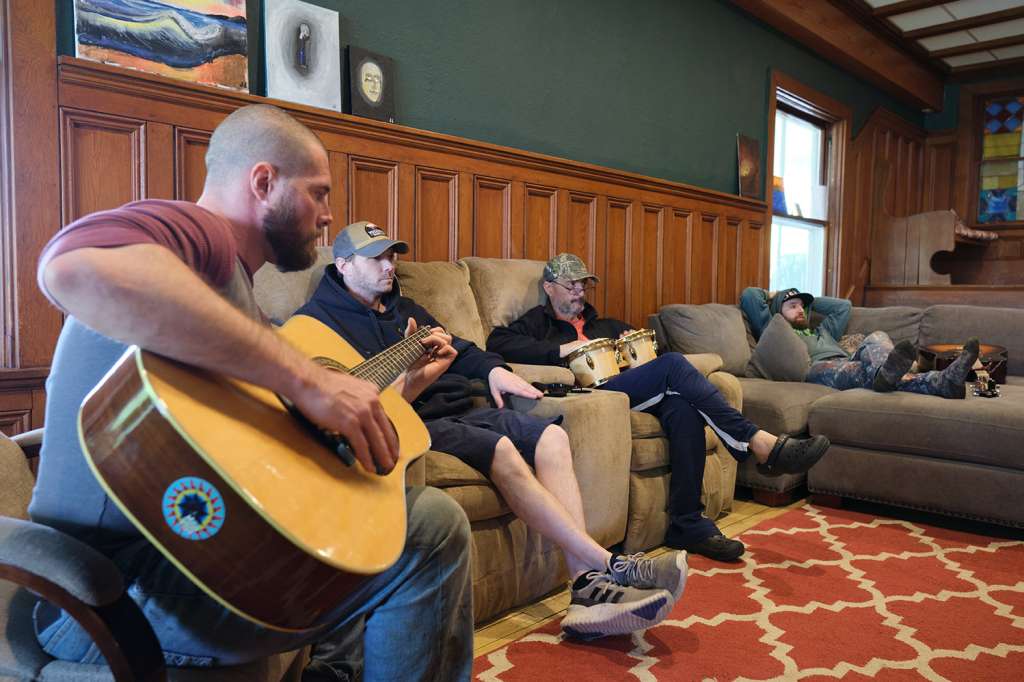
Brandhi guides the participants into this process of self- and joy-discovery by giving them mindfulness tools in weekly, individualized sessions. At their first meeting, he provides each student a blank journal in which the man shares his emotions and thoughts. These phrases become the lyrics for a personalized music video that Brandhi produces. Filled with poignant and expressive statements about pain, loss, and newfound hope, the music video becomes the individual’s personal mantra of recovery that moves him toward a previously unknown love and respect for self.
“You send somebody out with a song and a video of what they can be,” Brandhi says of the projects.
“I think the best tool I’ve come out of here with is just learning to love myself,” says S.S., addicted for 15 years. “That’s something that I really struggled with beforehand. I had really low self-esteem. And that’s been something that has really blossomed in my time here. I really started to appreciate who I am and understand who I am and start to love myself, because I didn’t understand who I was before.”
Jacob’s Ladder provides residents with a variety of musical instruments, as well as the recording equipment and studio for capturing and honing their musical expressions. For those who express themselves through visual arts, a studio provides painting and stained-glass creation opportunities, as well.
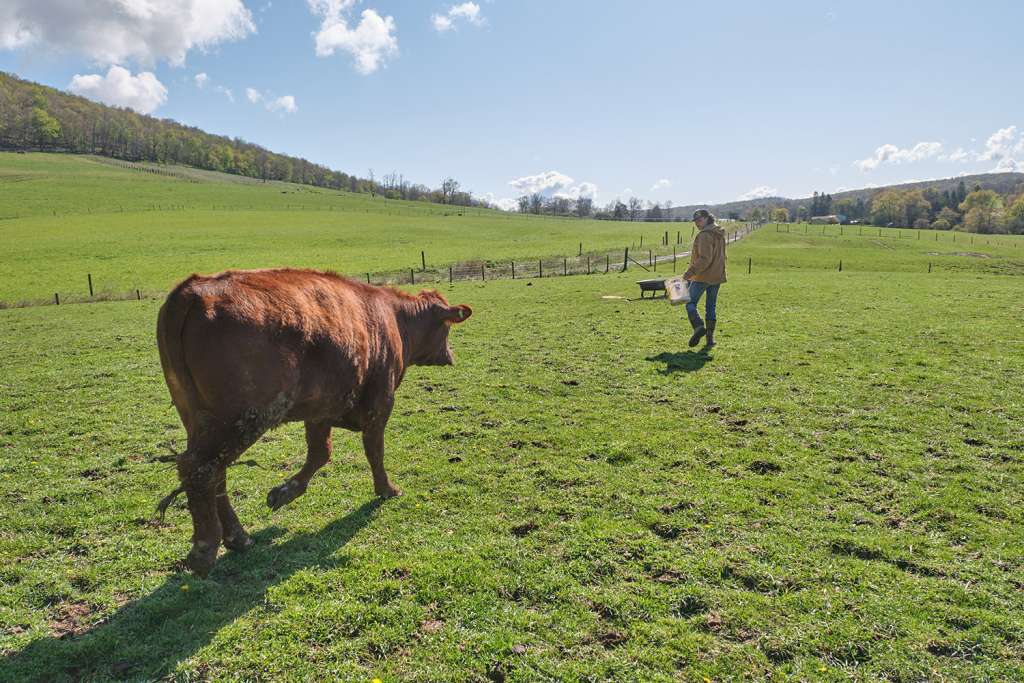
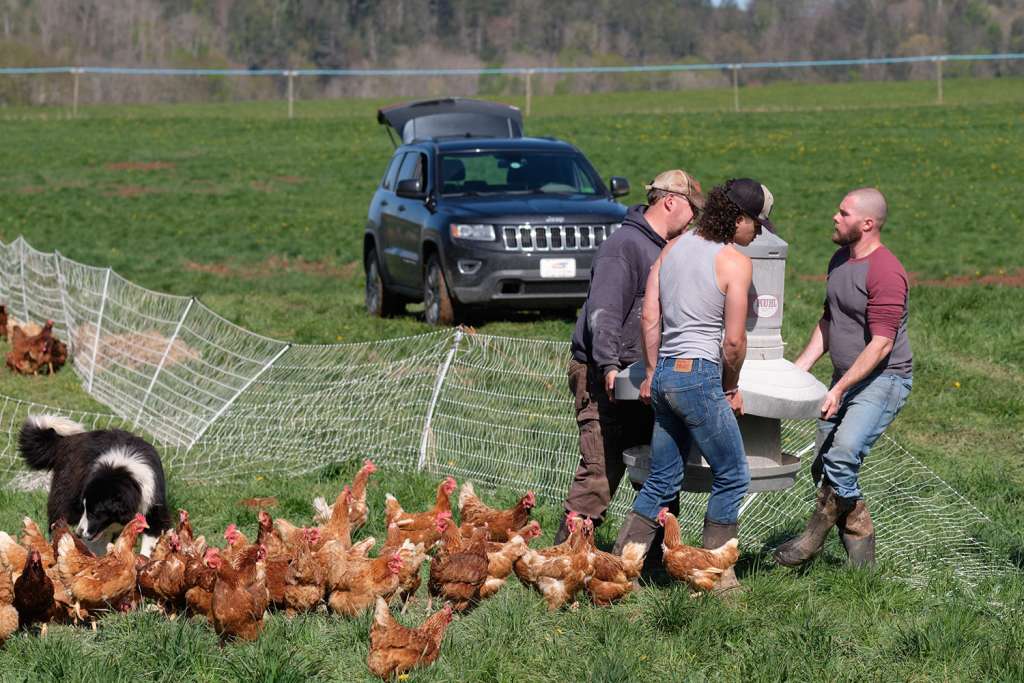
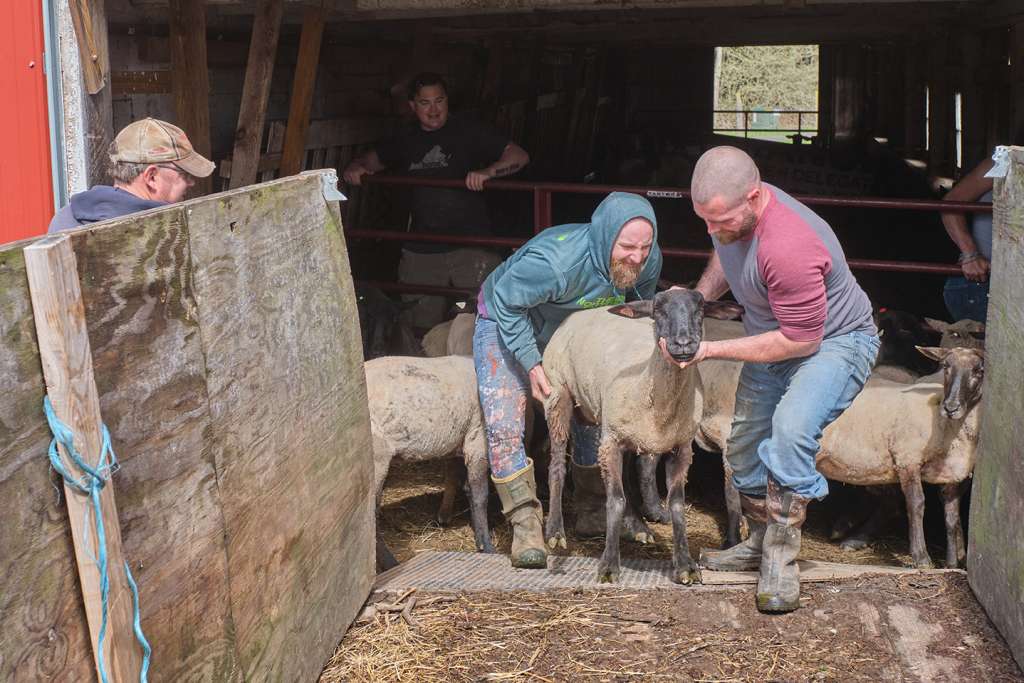
The landscape inspires creativity and reflection, with Cathedral State Park within walking distance and rolling farmland throughout the Allegheny Plateau community. At least twice a week, a group of the men head over to the Brookside Farm with Mark Utterback, who lives on and manages the farm. The men perform typical farm chores, from feeding the sheep, chickens, cattle, and hogs to repairing fences and machinery.
“I love going over the farm,” says S.S., whose prior farming experience was limited to horses. “Being here all winter long, you’re like kind of stuck up in this house with all the same guys, and the farm really breaks that up a lot. And I really enjoy the physical labor because that’s the type of labor (carpentry) I do at home.”
“I come from a line of farmers, but I didn’t have farming experience coming into this,” says E.P., a participant from Vermont. “But my goal is to start one of these back home.”
Making farmers of the men is not the program’s goal, however. “There are a few of the guys who say if they could magically plop down on a farm when they leave here, they’d do it … but, by and large, it’s not super financially viable. It’s a tough, tough thing to do, really,” observes Mark Utterback.
He is well qualified to speak of that difficulty. His parents, Edward and Mary, came into it as newlyweds and total novices in the early 1970s. Mary’s father, Dr. Andrew Mance, an Oakland, Maryland, physician, purchased the farm as an investment/historical preservation project. Three months after acquiring it, he approached his son-in-law and daughter with an offer to live on and operate the farm. Chicago residents with a young family and careers, the switch to farming was a huge change of scenery and careers for the couple.
“Mary wanted to come back, and I’d done a lot of different things in my life, so I figured, ‘I guess I can try this,’” Edward recalls. “In retrospect, I think, ‘What would I have done trying to raise four kids in the middle of Chicago?’ It was a good place to raise kids.’”
The family made a success of the farm and managed to preserve most of its original structures, which are part of the Brookside Historic District on the National Register of Historic Places. According to the application prepared by Courtney Fint Zimmerman of Aurora Research Associates, Brookside’s 11 listed structures date from the late 1800s to 1950. Most impressive, and visible from US Route 50, is the livery barn, a two-story, heavy-timber framed building with gabled roof and stone foundation. A large cupola with hipped roof and steep spire at the east end and primary entrance draw attention to the handsome, red structure. The barn has a central passageway running the entire 120 feet of its length. Animal pens are on either side of the passageway; the ground level ceiling is finished in tongue-and-groove maple, while wormy chestnut board-and-batten lumber cover the walls. The barn, sans the animals, would make a rustic, comfortable meeting house and has been used for that very purpose. Ed and Mary provided the structure to the Aurora Project for its annual barn dance prior to the Covid-19 restrictions.
Ed says living at Brookside piqued his interest in local history, which led to his involvement with the Aurora Project. The non-profit arts organization owns the former Brookside Cottages and Inn (Gaymont), whose constructions date range from 1885 to 1895. Aurora Project leases the Inn and several cottages to Jacob’s Ladder for housing and offices. Viola Wentzel, an Aurora Project board member, says Jacob’s Ladder put renovations worth $150,000 into the Gaymont building so it could function as the dormitory. The men did much of the work.
Jacob’s Ladder has been a godsend for the farm, although Chad Bishop admits there was initial community pushback, which the founder addressed through a series of public meetings. By 2014, when Dr. Blankenship was researching models for long-term residential treatment, Ed was nearing the end of his farming career. With only Mark to carry on the full load of the farm, the family was looking for other options.
“It got to the point where I said could not do it myself,” Ed says. And then, on a Sunday morning, Dr. Blankenship showed up at the farm with a proposal.
“(Blankenship) asked me, ‘Do you want to sell the farm?’” Ed recalls. “I should have said ‘yes.’ But I said ‘no, what are talking about?’ And he talked about the idea, and I said, ‘Doc, I’m getting old and don’t want to get tied up in that.’” However, as Ed learned more about the concept and how the farm could fit into it, he warmed up to the idea of renting the farm to the project—if Mark would come on as the farm manager and liaison to Jacob’s Ladder.
“Now, I’m sitting in my easy chair, watching TV,” Ed says. In practice, he’s often found outdoors with his son and the Jacob’s Ladder men assisting with the myriad chores.
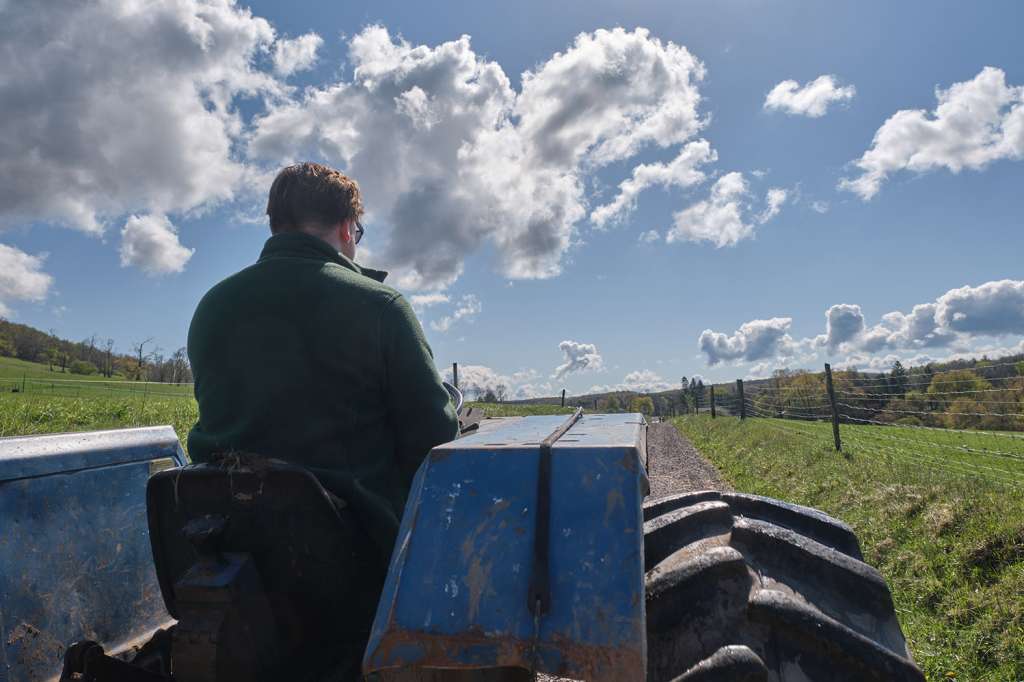
Mark says having the men available to work on the farm has allowed it to expand into a previously untapped opportunity. The 347-acre farm includes 110 acres of timber with a high percentage of maple. A forester had suggested the family tap the trees for maple syrup production, but the labor involved precluded expansion in that direction until the Jacob’s Ladder opportunity came along. A system of tubing is used to collect the sap from the maples that clothe the upper reaches of the farmland. Gravity delivers the sap to collection tanks along the farm road. From there, the sap is transported to the sugar house of Aurora producer Ron Stemple of Highland Maple, who helped Mark get the project up and running.
“Everything else that we do on the farm, I could take care of myself, but the maple lines are pretty labor intensive,” Mark says. “The local folks have been after me to do that for years, and this provided an opportunity to kind of take the leap we’ve taken.”
Chad Bishop says the farm is an essential component of Jacob’s Ladder and makes it unique among other residential treatment options across the nation.
“It’s a part of us that I don’t know if we would be what we are today if we didn’t have the farm. I hear it probably more than Mark does … that this makes the men feel like they’re not in a program,” Chad says. “And if you’re not forced to do a program, you’re more susceptible to learn … when you go into a clinical setting for rehab, you’re sitting there, you’re being groomed, all day. You may have four or five sessions a day here, too. (But), those guys get to go to the farm in the morning, and it’s like a freedom area for them and then their brain gets cleared out. They can come back in and process what they are going to learn in their next session or what they’ve already learned at a session. (The farm time) opens it up and gives them time to have their own time, their own free time.
“The farm is structurally based to get the guys away from the clinical version so they can process, have a more open mind,” he concludes.
“It’s just fun,” says J.T., a southwest Virginia man who graduated from Jacob’s Ladder after going through five prior programs without a farming component. “Mark is a great listener, as well (as a farm manager). He’s kind of one of the counselors … he listens to us and cares about us just as much as the staff up here on this part of the mountain.
“I think most of the guys would echo that the farm is one of their favorite things up here because it gets us outside,” he adds. “We feel like we are doing something very meaningful. And it’s pretty new for most of us.”
Mark works with the men in groups of three or four. Duties range from feeding the hundreds of cattle, sheep, chickens, and hogs to repairing fences and gathering the roughly 800 eggs that the flock produces daily. While a garden is not part of the farm—Mark says they tried it and grew some great weeds—Jacob’s Ladder’s leadership views the metaphor of farming as framework for what participants do during their six months.
“The one major concept (of a garden) is teaching them that you initially plant a seed but you’re not going to get instantaneous results. It’s going to take time for that seed to grow, and (it’s that way with) recovery. It’s not done in a day. It’s going to take a lifetime of continuing to water that and nourish it,” Mark says.
“With 28-day programs, you plant a seed, but you don’t get a harvest in 28 days,” Brandhi observes. “I don’t even see it coming up. It comes up unbeknownst to me, but I can see the change in that person over six months rather than 28 days.”
For many of the men, six months still is not long enough, however. A second program, Sober Living, provides a transition to work and living in the community after graduation from residential treatment.
“Most of our clients typically want to go to Sober Living in Morgantown,” Chad Bishop says. “Ninety percent of our guys have a job before they walk out this door, or at least have an interview set up for a job. So, we’re implementing a peer counselor at Sober Living, someone they can talk to, help them stay here, navigate the waters of dealing with triggers once they leave here. Triggers is something that clues in their brain that, ‘Oh, I want to go use’ because they may have just seen a movie that popped in their head or listened to a song that popped in their head (from the time) when they were actively using.”

“The thing that really lacked at the (five) treatment centers that I went to was aftercare,” says S.S. “And the aftercare at this place is really amazing. I think that is one of the big benefits of it, why they have such a good success rate it. They do all the planning to set up where you live in the halfway house, how they’re really supportive of making sure you stay connected … they really do a lot to make sure that you stay successful after you leave here.”
“We’ll always be beside you. This is family,” says Elias Tancin, a counselor who continues to work with the men at Sober Living. “As long as you keep doing the next right thing, I promise it’ll get better. I promise. So, stay connected. I couldn’t be more proud of you. And I love you.”
Living in Morgantown also gives the men continued access to the outdoor therapies that are part of their time at Jacob’s Ladder. Weekly excursions into forests, river adventures, and rock heights give the men healthy alternatives to artificial highs. “I had never been up to this part of West Virginia before but had had heard great things about how beautiful it is,” says R.B. “When we were working on the maple lines, we would look back down on the valley, and it’s gorgeous. This is a wonderful part of the country.”
“The last treatment program I was in had an outdoor component, but we did it just once a week. It was O.K., we went hiking and zip-lining, and we realized while we were there that it is fun to be sober and clean, but there just wasn’t enough time to cycle through all the mental health issues. This really helped me be sober and clean in an in-patient environment,” he adds.
Chad Bishop says the program relies upon an Internet presence to inform prospective participants of its programming and uniqueness. In 2018, it received a significant boost from a documentary film, Recovery Boys, directed by Nicholas County native and award-winning filmmaker Elaine McMillion Sheldon. The film followed four men through their Jacob’s Ladder treatment. Filmed when Jacob’s Ladder was just getting started, it reveals the hard work, struggles, disappointments, failures, and triumphs involved in the work performed in Aurora. The documentary was picked up by Netflix and has been responsible for numerous applications and inquiries into the program. S.S. says his mother became aware of Jacob’s Ladder through watching the film on Netflix.
The clients featured in the film are from West Virginia and highlight the ongoing addiction struggles present in Appalachia. However, these days most of the clients at Jacob’s Ladder come from outside the state and from all walks of life.
“It doesn’t matter where you come from if you’re upper echelon or low bottom,” Chad Bishop says. “Addiction doesn’t stereotype. It is everywhere and affects all families, no matter the social-economic status.”
Jacob’s Ladder gives the men the connections, tools, and experiences to help them climb the ladder to sustained sobriety.
“You got all the tools,” Chad told J.T. on his graduation day. “You got to live the life that you’ve been reading about and been practicing. Start that routine when you walk out of this facility and go off the mountain.”